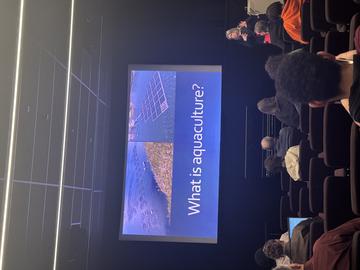
The Ian Ramsey Centre hosted its first lecture for Hilary Term 2026, on 2 Feb 2026, with Dr Clair Linzey (Research Fellow in Animal Ethics in Wycliffe Hall, University of Oxford) presenting on 'Aquaculture: A Moral, Theological, and Scientific Assessment’. The event occurred in the Cinema Theatre in the brand new Schwarzman Centre for the Humanities.
Aquaculture is often presented as a sustainable alternative to traditional commercial fishing of free-living fishes: A solution to overfished oceans and rising global demand for protein. But as Dr Linzey highlighted, the scale alone raises serious ethical and environmental questions. An estimated 3 trillion fish are farmed for human consumption every year. Even more striking, around 480 million additional fish are reared solely to feed farmed fish, revealing a system that depends on slaughtering smaller free-living fish and feeding them intensively farmed species as fish meal or oil. Rather than relieving pressure on marine ecosystems, parts of aquaculture may be redistributing and even intensifying it.
These numbers are difficult to comprehend, and that in itself was part of the lecture’s point: When suffering occurs on such a vast scale, it becomes easy to overlook.
Much of the discussion centred on the moral status and welfare of fish, animals who have historically received far less ethical consideration than land mammals. Increasing scientific evidence shows that fish are sentient beings capable of experiencing pain and joy as well as a wide variety of emotions – fear, anxiety, trauma etc. As well as being cognitively complex in comparable ways to mammals.
From a theological perspective, the lecture raised profound questions about human responsibilities toward creation. If fish are part of the community of living creatures, what does it mean to subject trillions of them to lives of confinement and early death for the sake of inexpensive food?
One of the most urgent scientific concerns discussed was the role of aquaculture in antibiotic resistance. In many intensive fish farming systems, antibiotics are used not only to treat disease but also preventatively in crowded conditions where infections can spread rapidly. This creates an environment in which antibiotic-resistant bacteria can emerge and proliferate, potentially spreading beyond farms into surrounding waters and, ultimately, into human and animal populations. Antibiotic resistance is already recognised as a major global health threat, and the contribution of food production systems (including aquaculture) is an increasing focus of scientific and policy concern.
Dr Linzey suggested that current practices expose a kind of moral inconsistency: Societies that increasingly recognise animal welfare in some contexts often ignore it when it comes to fish, despite the overwhelming numbers involved.
This lecture was organised as part of the termly Ian Ramsey Centre for Science and Religion Lectures. For more information join our mailing list by registering on this form: Click here to access the mailing list registration form.