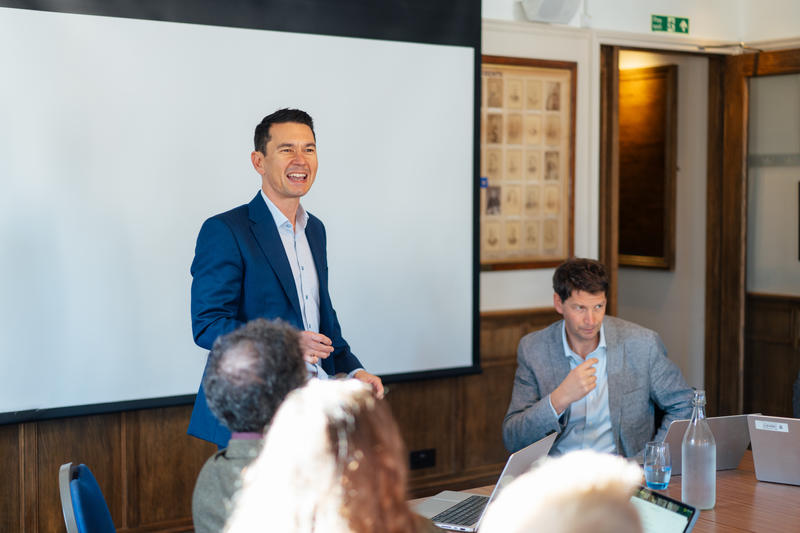
"[A] growing majority of the world's population has some kind of religious affiliation. In addition, it is increasing. AI is going to transform society. Therefore, the reasons why AI interacts with society must include at least one explanation that makes sense for religious people." – Dr Lyndon Drake, translated excerpt from the EL PAÍS interview.
Research led by scholars in the Faculty of Theology and Religion at the University of Oxford has been featured in the Spanish newspaper EL PAÍS, highlighting the development of the Oxford Oath for AI Practitioners: a proposed ethical commitment for those working in artificial intelligence.
The article, titled ‘El reverendo que quiere poner límites a la IA con un código ético: “La teología lleva siglos reflexionando sobre los problemas que plantea esta tecnología”’ (translated: ‘The Reverend Who Wants to Limit AI with an Ethical Code: “Theology has been reflecting on the problems posed by this technology for centuries”’), profiles Dr Lyndon Drake, who serves as operational lead for the Oxford Collaboration on Theology and Artificial Intelligence (OCTAI).
The published piece traces Dr Drake’s vocational journey across banking, ordained ministry, and AI ethics, drawing attention to his work on the Oxford Oath, which is one of the major outcomes of OCTAI's collaborative initiative.
OCTAI is a collaborative, interdisciplinary project hosted by the Ian Ramsey Centre for Science and Religion at the Faculty of Theology and Religion, University of Oxford. The OCTAI project is funded by a generous donation from the John Templeton Foundation. It is led by a core team which, from the Faculty of Theology and Religion at the University of Oxford includes Professor Mark Harris, Professor Joshua Hordern, Professor Andrew Davison, Dr Lyndon Drake, and Dr Stan Rosenberg. Core team members from other institutions include Professor Sarah Spiekermann-Hoff (Vienna University of Economics and Business), Professor Sara Lumbreras (Comillas University), Professor Nigel Crook (Oxford Brookes University), Associate Professor Michael Burdett (University of Nottingham), and Patricia Shaw (Beyond Reach). The initiative also features active participation from business leaders, AI engineers, and academics across multiple departments at Oxford and other worldwide universities.
The Oxford Oath draws inspiration from the Hippocratic Oath in medicine. Rather than prescribing technical rules, it seeks to cultivate an professional ethos: encouraging AI practitioners to place the common good above narrow optimisation, and to ensure that artificial systems serve human flourishing.
In the interview, Dr Drake observes that theology has been reflecting for centuries on many of the issues now intensified by AI technologies.
“[Artificial Intelligence] is positive in areas such as medicine: detecting diseases before they develop, will save lives. But the risk is that we will lose the [human] ability to make those diagnoses. Or think of autonomous weapons: they can save lives in a just war, but in the hands of those who wage an unjust war, the damage is devastating. And the problem is that we almost never agree on which war is just." - Dr Lyndon Drake, translated excerpt from the EL PAÍS interview.
In the interview, Dr Drake addresses emerging questions, concerning language and meaning, moral responsibility, human dignity, and the limits of human power, in the context of rapidly evolving AI capabilities, and argues that these dilemmas are longstanding theological concerns, now refracted through new technological forms.
The Oath, which is now being distilled into a final draft, includes a foundational commitment to affirm that human beings possess moral value superior to that of any artificial entity, and that AI must remain at the service of human dignity. It aims to complement (and not replace) regulatory frameworks such as the European AI Regulation, contributing a shared moral vocabulary to accompany legal oversight.
“An oath is made through individual and community consciousness. It doesn't dictate laws, but it creates an ethos. If individuals and the community sign it, we can question each other if our actions contradict thecommitment. Society needs both laws (such as the European AI Act) and a shared moral framework that gives social legitimacy to the industry.” - Dr Lyndon Drake, translated excerpt from the EL PAÍS interview.
The OCTAI group is currently refining the text of the Oath through consultation with scholars and industry practitioners. The ambition is to produce a durable ethical framework capable of guiding innovation over the long term.
This collaborative work exemplifies the Faculty’s wider commitment to interdisciplinary research at the intersection of theology, technology, and public life, demonstrating how theological scholarship contributes to contemporary global debates about the future of artificial intelligence.
Read the full feature in EL PAÍS..
Read more about the OCTAI project here.