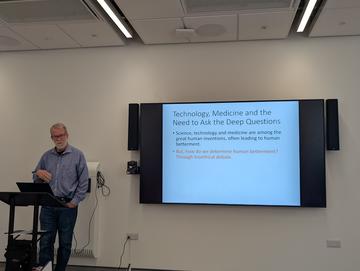
This past week, the Ian Ramsey Centre hosted Professor John Evans’ talk on The History and Future of Religion in U.S. Bioethics. Evans was particularly considering the relationship between Bioethics and religious voices. Speaking from his background as a Sociologist, Evans traced the development of Bioethics in the U.S. Evans noted that prior to the 1970s, there was no ethical oversight of the medical field, which he framed as “jurisdiction creep.” Ethical questions about human life and fair treatment, which were once the jurisdiction of Theologians and Philosophers, were taken over by doctors and scientific researchers, on the basis of their scientific expertise. Evans notes that this is the sign of a strong field, its ability to increase its jurisdiction into the spaces that were once occupied by other fields, (e.g. Scientific Naturalism). According to Evans, it was theologians who first argued for the dignity and autonomy of patients, both in the operating room, and in clinical trials, in response to horrific instances of medical malpractice. The clear need for ethical oversight led to the creation of Bioethics, which was intended to provide external oversight, leading Theologians who were interested in such questions to remake themselves in the image of more generic Bioethicists to gain more reach in the field. According to Evans, in recent years, Bioethics has been integrated more fully into the medical field, making it increasingly difficult for proper oversight, because of the inherent difficulty involved in critiquing any industry from within. As we move forward, Evans sees the possibility of theologians reclaiming their jurisdiction over various ethical questions in scientific fields as a form of course correction, particularly within the United States where so many people are religious, but only if they are able to maintain their identities as Theologians, rather than merely Bioethicists.
Reflecting on the talk, I am very interested in how the history of Technoethics might come to mirror Bioethics. It strikes me that questions surrounding human ontology are being radically redefined by researchers at the forefront of the A.I. revolution, with apparently little meaningful oversight from Philosophers or Theologians. I think that this reflects a similar “jurisdiction creep” to what took place in ethical questions surrounding medical treatments and research in the 20th century. Evans noted that it was the government who ultimately stepped in to establish Bioethics, it will be interesting to see if the government eventually steps in to establish outside Technoethics, or if we will be left to the ethical decisions of large corporations and technological researchers as A.I. advances, shifting what it means to be human.
This was a Public Seminar was organised as part of the termly Ian Ramsey Centre for Science and Religion Lectures. For more information join our mailing list by registering on this form: Click here to access the mailing list registration form.