
Why was God Determined to Create Quantum Mechanics?
IRC Director Mark Harris delivered a keynote lecture at the 2026 Science and Religion Forum Conference
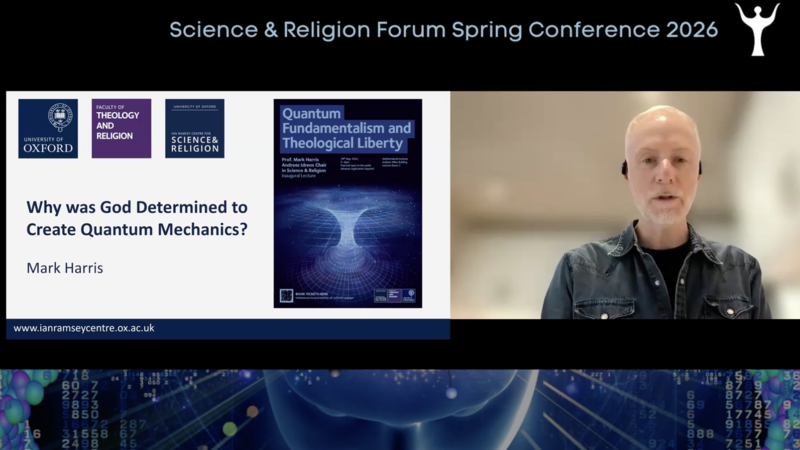
Click here to watch the full video on YouTube
Quantum indeterminacy has long been celebrated as a lifeline for theologians. Where classical Newtonian physics seemed to leave no room for divine action (its rigid determinism appearing to lock the universe into a fixed, predictable course) the arrival of quantum mechanics in the twentieth century appeared to change everything. Suddenly, the future seemed genuinely open, and with it, the possibility of divine influence and human free will.
But is quantum indeterminacy really the theological rescue it is often claimed to be?
In his keynote lecture at the Science and Religion Forum's recent online conference, Grains of Sand & Stars in the Sky: Science and Theology from the Microscopic to the Cosmic (15–16 May 2026), IRC Director, Professor Mark Harris urged his audience to look more carefully. Drawing on his background as both a condensed-matter physicist and a theologian, Harris highlighted problems in standard theological accounts of quantum indeterminacy that are frequently overlooked.
But his deeper interest goes further: rather than simply asking whether quantum mechanics helps theism, Harris asks what quantum indeterminacy might reveal about the nature of God as creator: if we are willing to take it seriously on its own terms.
It is a question that reframes the conversation entirely, moving from defence to discovery.
Watch the full keynote on the Science and Religion Forum's YouTube channel, and visit srforum.org to find out about future conferences. Click here to access the link.

